

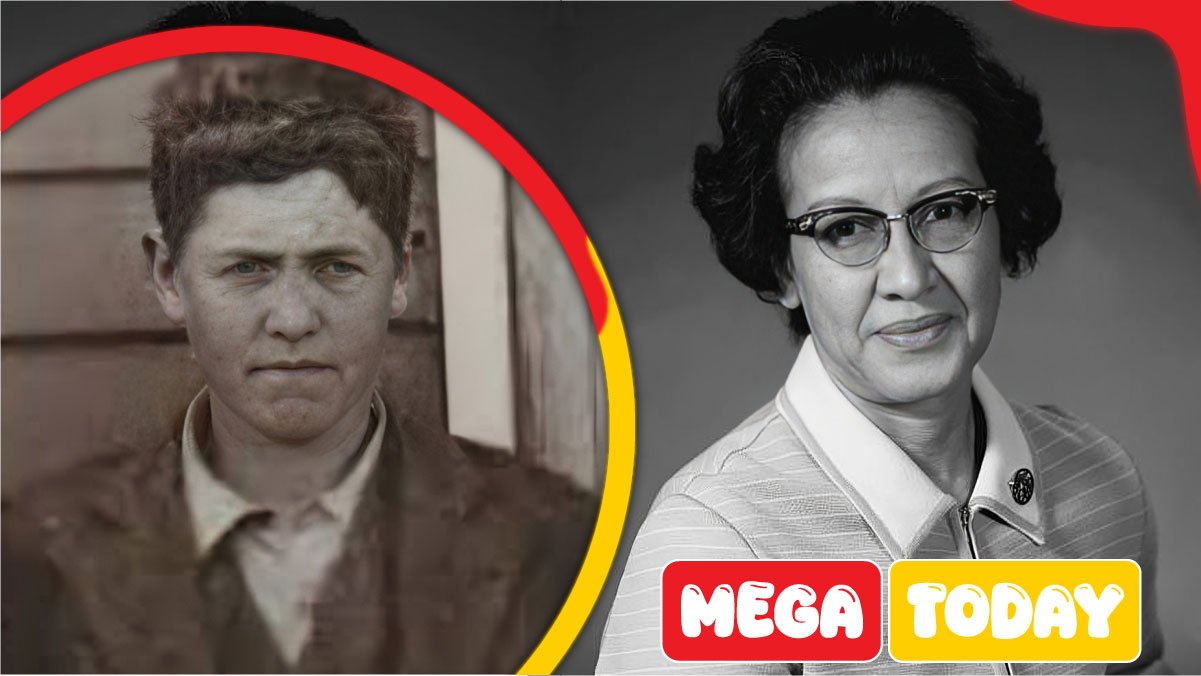
When Hollywood brought the story of NASA’s “human computers” to the big screen in Hidden Figures, audiences fell in love with Katherine Johnson — the brilliant mathematician whose calculations launched astronauts into orbit. But behind every groundbreaking woman is a network of people who helped make her success possible. For Katherine, that story began with James Francis Goble, the man she married in 1939, raised three daughters with, and built a life alongside during one of the most turbulent eras in American history.
Most biographies mention him in passing. A footnote. A name on a family tree. But James Francis Goble was far more than a historical afterthought. He was a father, a husband, a worker, and a man who quietly supported one of the greatest scientific minds of the 20th century — until his life was cut tragically short.
James Francis Goble was Katherine Johnson’s first husband, born in 1913 in southwestern Virginia. He married Katherine Coleman in 1939, became the father of three daughters, worked as a laborer to support his family, and died from an inoperable brain tumor in 1956 at the age of 43.
Quick Facts: James Francis Goble at a Glance
| Fact | Details |
| Full Name | James Francis Goble |
| Born | 1913 (exact date unconfirmed) |
| Birthplace | Marion, Virginia area (reportedly) |
| Died | 1956 |
| Date of Death | 1956 (exact date unconfirmed) |
| Age at Death | 42–43 years old |
| Cause of Death | Inoperable brain tumor |
| Nationality | American |
| Ethnicity | African American (reportedly) |
| Profession | Shipyard laborer; reportedly a chemistry teacher |
| Spouse | Katherine Coleman (m. 1939) |
| Children | 3 daughters: Constance, Joylette, and Katherine |
| Known For | First husband of NASA mathematician Katherine Johnson |
| Net Worth | Not publicly documented |
Early Life and Family Background
James Francis Goble entered the world in 1913, growing up in the rugged, coal-country landscape of southwestern Virginia. He was reportedly one of 13 children born to Charles and Anna Goble, a working-class family rooted in the tight-knit community around Marion, Virginia.
Life in rural Virginia during the early 1900s was not easy — especially for African American families navigating the deep-seated segregation and economic hardship of the Jim Crow South. Large families were common, and every able-bodied member contributed. For James, that meant learning the value of hard work early. He did not come from wealth or privilege. What he had was a family network, a strong back, and the determination to build something better.
The town of Marion sat in Smyth County, a region where the railroad and coal industries provided the steadiest employment for Black workers — though “steady” was a relative term. Wages were low, housing was segregated, and educational opportunities for African American children were deliberately limited. Schools for Black students were underfunded, understaffed, and often closed for months so children could help with farmwork or domestic labor.
Despite these obstacles, the Goble family valued schooling. In an era when many Black children in rural Virginia never made it past elementary school, James’s path to West Virginia State College suggests his parents prioritized education. Getting to college required resources, transportation, and a belief that higher learning was worth the sacrifice. For a family with 13 children, that sacrifice was enormous.
Details about his childhood remain scarce. Unlike his famous wife, no one kept meticulous records of his early schooling or childhood milestones. But the environment shaped him. Southwest Virginia in the 1910s and 1920s was a place where survival required resilience. The Goble family, like countless African American families of the era, made do with limited resources while nurturing ambitions for the next generation.
That ambition would eventually lead James to West Virginia State College, a historically Black institution in Institute, West Virginia. It was there that his path would cross with a young woman named Katherine Coleman — and everything would change.
Education and Personal Life
James Francis Goble attended West Virginia State College, where he met Katherine Coleman, a math prodigy who had enrolled in college at just 14 years old after graduating high school early. The two formed a connection that would deepen into a lifelong partnership — though, tragically, not a long one.
Katherine was extraordinary from the start. She took every mathematics course available, graduating summa cum laude in 1937 with degrees in mathematics and French. James, by contrast, walked a more conventional path. Some sources suggest he studied chemistry, though this remains unverified. What is clear is that the couple shared a belief in education as a ladder out of poverty and limitation.
In 1939, James Francis Goble and Katherine Coleman married. It was a pivotal year for both of them. Shortly after their wedding, Katherine made history as one of the first African American women to attend graduate school at West Virginia University — a groundbreaking achievement following the Missouri ex rel. Gaines v. Canada Supreme Court ruling. She was the only woman among three Black students selected to integrate the university’s graduate program.
But the pull of family life proved strong. After just one session, Katherine left graduate school to focus on her new marriage. It was a decision that reflected the realities of the era: even brilliant women were expected to prioritize home and hearth. James Francis Goble and Katherine settled into married life, and soon their family began to grow.
The 1940s were a defining decade for the young couple. World War II reshaped the American economy, creating industrial jobs in shipyards and factories while millions of men served overseas. For Black families in the South, the war brought both opportunity and tension — better wages in defense industries, but persistent discrimination in hiring, housing, and daily life. The Gobles navigated all of it together.
Career and Individual Achievements
Here’s where the record gets murky — and where James Francis Goble deserves more than a passing mention.
According to genealogical records and WikiTree documentation, James worked as a shipyard laborer in Newport News, Virginia. It was grueling, blue-collar work — the kind that kept food on the table and a roof overhead during the 1940s and early 1950s. Shipyard jobs were plentiful in the Hampton Roads area, especially during and after World War II, but they demanded long hours and physical endurance.
Also Read: Who Is Francis Greco? Exclusive Look at Lauren Holly’s Ex-Husband
The Newport News Shipbuilding and Dry Dock Company was one of the largest employers in Virginia, building warships and commercial vessels that supplied the Allied war effort. For African American workers, shipyard jobs paid better than farm labor or domestic service, but they also exposed workers to dangerous conditions: toxic paint fumes, heavy machinery, and the constant risk of injury. The work was backbreaking, honest, and largely invisible to the outside world.
Some sources, including social media biographies and secondary accounts, have described him as a chemistry teacher. This claim is harder to verify. If true, it would suggest he pursued teaching after his college studies — a respectable path for a man of his background. However, credible outlets like Wikipedia and NASA-related biographies consistently identify him as a laborer. Any reference to a teaching career should be treated as reportedly accurate, not confirmed.
What matters most is this: James Francis Goble was the financial and emotional anchor of his household while Katherine raised their children and eventually returned to teaching. When NACA (the precursor to NASA) came calling in 1952 with an opportunity for Katherine to work as a “computer” — performing complex mathematical calculations by hand — James supported the family’s move to Newport News in 1953.
That move changed American history. Without James’s willingness to relocate and hold down the home front, Katherine Johnson might never have walked through the doors of Langley Memorial Aeronautical Laboratory. His role was quiet, uncelebrated, and absolutely essential.
Relationship with Katherine Johnson
The love story between James Francis Goble and Katherine Coleman began on a college campus in West Virginia and unfolded across nearly two decades of marriage, three daughters, and a country in the throes of social transformation.
Their marriage in 1939 was not glamorous. There were no magazine profiles or red carpets. What they built was something far more durable: a partnership rooted in mutual respect and shared sacrifice. Katherine would later describe her husbands — both James and her second husband, James A. Johnson — as supportive men who never tried to dim her light.
The couple had three daughters: Constance Goble, Joylette Goble, and Katherine Goble (sometimes called Kathy). Raising three girls in the segregated South required every ounce of strength the Gobles possessed. Katherine taught school, James worked long hours, and together they created a home where education and ambition were sacred values.
Family life for the Gobles looked much like that of other working-class African American families in the mid-20th century. Sunday church services. Homework at the kitchen table. Careful budgeting. Dreams deferred and dreams pursued. Katherine reportedly encouraged her daughters to study mathematics and science, just as her own mother had encouraged her. James backed those ambitions with paychecks from the shipyard — paychecks that shrank when illness eventually took hold.
When the family relocated to Newport News in 1953, the dynamic shifted. Katherine took a job at NACA’s West Area Computing section, working under fellow pioneer Dorothy Vaughan. She performed calculations for aircraft research, eventually moving into the flight research division alongside white male engineers. It was groundbreaking work — and it was work she could not have pursued without the stability James Francis Goble provided at home.
Their daughters were still young when Katherine started at NACA. Managing a household, caring for children, and performing world-class mathematics required a division of labor that James accepted without resentment. In an era when many men demanded their wives stay home, James Francis Goble made space for Katherine’s genius.
Theirs was a marriage of equals in spirit, if not in public recognition. While Katherine’s star rose at NASA, James remained in the background — a choice not of weakness, but of love. He did not need the spotlight. He needed his family to thrive.
James Francis Goble’s Death and Its Impact
In the mid-1950s, James Francis Goble began experiencing health problems that would escalate into a prolonged, devastating battle. He had been diagnosed with an inoperable brain tumor — a death sentence in an era before modern neurosurgery and chemotherapy.
James Francis Goble died in 1956. He was just 42 or 43 years old, leaving behind a wife in her late thirties and three young daughters. The cause of death was the brain tumor that had slowly robbed him of his health and vitality. According to Find a Grave and genealogical sources, his final months were marked by a “protracted fight with cancer” — a quiet, painful struggle that Katherine and their children endured privately.
Medical care in the 1950s offered little hope for brain tumor patients. Surgery was risky and often impossible depending on the tumor’s location. Radiation therapy was crude by today’s standards. For working-class families like the Gobles, the financial burden of prolonged illness could be as devastating as the disease itself. Katherine faced the dual tragedy of losing her husband while managing mounting medical expenses and an uncertain future.
His death was a seismic blow to the family. Katherine, now a widow, faced the unimaginable task of raising three girls alone while working in a segregated, male-dominated government agency. But she did not break. If anything, James’s death may have sharpened her resolve. She had a family to feed, daughters to educate, and a mind that refused to be wasted.
Three years later, in 1959, Katherine remarried. Her second husband was James A. “Jim” Johnson, a U.S. Army officer and Korean War veteran. They would remain married for 60 years, until his death in 2019. But James Francis Goble was the foundation — the first man to believe in her, build a life with her, and father the children who would carry their legacy forward.
Net Worth and Lifestyle 2026
Attempting to calculate a net worth for James Francis Goble in 2026 is an exercise in historical imagination. There are no financial records, no property deeds in the public domain, and no estate documents that have surfaced.
What we know is this: the Goble family lived a working-class lifestyle in Newport News, Virginia. Their home was modest. Their budget was tight. Katherine’s salary at NACA, and later NASA, was the primary source of income — especially as James’s health declined and he could no longer work.
By today’s standards, they would likely be considered lower-middle class. The family did not accumulate wealth in the traditional sense. What they built was something far more valuable: intellectual capital, educational opportunity, and a legacy of excellence that would eventually be celebrated by Presidents and Hollywood alike.
If we were to attach a monetary figure to James Francis Goble’s contribution, it would be incalculable. The trajectories he helped enable — both literally, through Katherine’s calculations for John Glenn and Apollo 11, and figuratively, through the daughters he raised — are worth infinitely more than any bank account balance.
Frequently Asked Questions
How did James Francis Goble die?
James Francis Goble died of an inoperable brain tumor in 1956. His illness was reportedly prolonged and difficult, lasting months before his death at approximately age 43.
Was James Francis Goble white?
No. James Francis Goble was African American, according to genealogical and historical records. He and Katherine Johnson were both Black Americans navigating life in the segregated South.
How old was James Francis Goble when he died?
James Francis Goble was approximately 42 or 43 years old when he died in 1956. He was born in 1913, though his exact birth date has not been widely documented.
How many children did James Francis Goble have?
James Francis Goble had three daughters with Katherine Johnson: Constance Goble, Joylette Goble, and Katherine Goble. All three were raised in Newport News, Virginia.
What did James Francis Goble do for a living?
According to verified sources, James Francis Goble worked as a shipyard laborer. Some secondary accounts have described him as a chemistry teacher, though this has not been confirmed by major biographical outlets like Biography.com or NASA-affiliated sources.
Who was Katherine Johnson’s second husband?
After James’s death, Katherine married James A. “Jim” Johnson in 1959. He was a U.S. Army officer and Korean War veteran. The couple remained married for 60 years until his death in 2019.
Is there a photo of James Francis Goble available?
No widely circulated photo of James Francis Goble has been published in major media outlets. Unlike Katherine, who lived to 101 and was extensively photographed, James died before the digital age and before his wife became a household name. Family historians and genealogical researchers continue to search for images.
Written by an entertainment journalist covering celebrity profiles and pop culture.
Visit Our Site for More: MegaToday
Stay connected with MegaToday—reach out to us for inquiries, feedback, or partnerships.
