

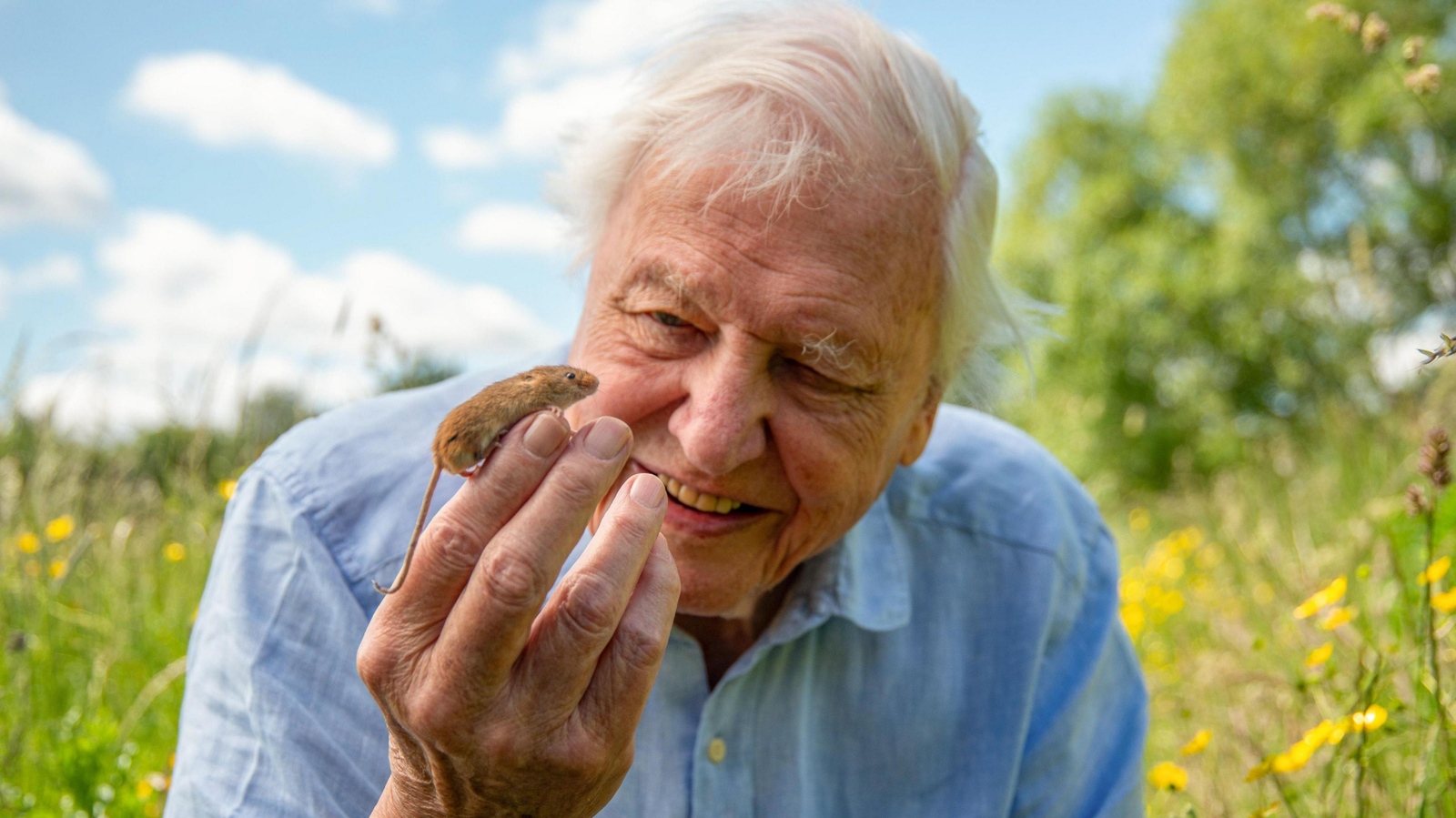
David Attenborough’s public identity rests on familiar elements: a measured voice, a blue shirt, an attentive expression and an animal behaving in a way television has never shown before. His story is not a sequence of famous programmes. It is a record of curiosity repeatedly redirected by chance, followed by unusually firm decisions about how television should treat knowledge.
Five objects help reveal that wider life. A piece of amber connects his childhood to deep time and European history. An old television camera represents a career that almost kept him out of view. A controller’s desk marks the years when he shaped British broadcasting without discussing animals on screen. A passport carries both thrilling encounters and private costs. A microphone traces his gradual change from observer to environmental advocate. Together, these objects explain why his career endured long after the expedition format that first made him famous had disappeared.
The Amber: A Childhood Built Around Curiosity
David Frederick Attenborough was born in Isleworth, west London, on 8 May 1926, but Leicester formed the world he first explored. His father, Frederick, became principal of University College Leicester, later the University of Leicester, and moved the family onto its campus when David was five. The college occupied a building that had previously served as a Victorian mental hospital. Some padded rooms remained, giving the three Attenborough brothers an unusual place to roam. Richard, the future actor and director, once locked David in one of them as a prank.
The campus gave David access to adults who treated knowledge as an active pursuit. Academics arrived with specimens, books and accounts of research, while the surrounding countryside supplied raw material for his own collections. He gathered stones, fossils and natural objects with the seriousness of a young curator. At seven, he received a piece of fossilised limestone containing sea creatures. The thought that rock beneath ordinary English fields preserved evidence of vanished life captivated him.
One small possession linked natural history with a larger human story. In 1939, David’s parents took in Irene and Helga Bejach, Jewish sisters who had escaped Nazi Germany through the Kindertransport. They lived with the Attenborough family for about seven years and became sisters to David, Richard and their younger brother John. Irene gave David a piece of amber containing insects trapped millions of years earlier. The gift strengthened an interest in deep time while carrying the memory of a family divided by persecution.
Young David also found ways to turn curiosity into small transactions. He reportedly supplied newts to the university’s zoology department, receiving payment for specimens collected from a pond close to campus. The department did not initially realise that he was returning to the same convenient source. The story shows an enterprising streak beneath the sober public manner he later developed. It also belongs to an era when collecting wildlife prompted fewer ethical questions than it does today.
School sharpened his scientific interests without deciding his future profession. He attended Wyggeston Grammar School for Boys and won a scholarship to Clare College, Cambridge, where he studied geology and zoology. His degree gave him a framework for interpreting the objects he had collected since childhood. Rocks became records of environmental change, while anatomical differences offered evidence of evolution. He learned to connect individual specimens with processes operating across immense periods.
Attenborough has resisted the simple description of himself as an animal lover. Fascination is closer to his stated position. Affection can favour attractive creatures, but fascination asks why a parasite, fungus, reptile or carnivorous plant behaves as it does. That distinction became central to his programmes. He did not need every organism to appear charming. He needed its existence to pose a question worth pursuing.
The Unwanted Television Face: Failure, Chance and Zoo Quest
Attenborough entered broadcasting through a rejection. He applied to become a BBC radio talks producer in 1950 but did not get the job. His application nevertheless reached Mary Adams, who led factual programming for the young television service. She offered him training and eventually brought him into the BBC full time in 1952. Television carried less prestige than radio, and Attenborough did not own a set. He had watched only a small amount of television before joining the organisation that would define his working life.
Early executives did not immediately see a presenter in him. One assessment judged him intelligent but unsuitable as an interviewer because his teeth appeared too large on screen. The comment sounds absurd after decades in which his face became globally recognisable. At the time, it directed him towards production, where he learned how to organise live discussions, choose visual material and translate specialist knowledge for viewers.
Zoo Quest began in 1954 as a collaboration with London Zoo. The programme followed expeditions seeking animals for the zoo while filming wildlife and local communities along the route. Jack Lester, a zoo curator, was intended to present the series, while Attenborough produced it. Lester became ill after the first expedition, leaving Attenborough to take the visible role. Professional necessity achieved what BBC opinion had discouraged: it put him in front of the camera.
Attenborough’s presenting style developed through those practical conditions. Loud performance would have competed with the subject, and complicated language would have burdened sequences already filled with unfamiliar species and locations. He spoke directly, handled animals calmly and allowed behaviour to provide much of the drama. His excitement remained visible, but it rarely displaced the explanation. The approach later became so familiar that it can seem inevitable; in fact, it grew from production constraints and personal temperament.
Zoo Quest also belongs to a different ethical period. Its expeditions captured animals and transported them to London Zoo, an aim openly built into the title and structure. Modern natural-history teams generally seek footage rather than living specimens, and audiences now scrutinise interference with wildlife more closely. Ignoring that difference would turn biography into admiration. Attenborough’s long career matters partly because his work changed as scientific practice, zoo policy and public expectations changed.
The Controller’s Desk: When Attenborough Remade Television
Attenborough became controller of BBC Two in 1965, taking charge of a channel still defining its purpose. He had to fill schedules, manage budgets and distinguish the station from BBC One. Natural history occupied only part of that task. Drama, sport, comedy, music, archaeology, business and the arts all needed forms suited to television rather than borrowed unchanged from radio or theatre.
Colour broadcasting created his most visible technical challenge. BBC Two launched Europe’s first regular colour television service in 1967, beginning with Wimbledon coverage. Attenborough understood that colour needed programmes that demonstrated its value rather than simply repeating monochrome schedules with brighter images. Tennis presented a practical problem because white balls could be difficult to follow on screen, and his later intervention contributed to broadcasters adopting yellow balls.
Snooker offered an ingenious showcase. Pot Black placed coloured balls against green baize, making the new service’s advantage immediately clear. The programme also helped turn a sport previously associated with clubs and quiet halls into popular television. Its success reflected Attenborough’s managerial instinct: technology becomes meaningful when viewers can see what it changes.
Serious culture received equally ambitious treatment. He backed programmes that trusted audiences with detailed subjects, including Kenneth Clark’s Civilisation, a thirteen-part history of Western art designed for colour television. The channel also developed eclectic comedy, discussion, music and documentary programming. Attenborough did not personally invent every famous series later attached to his management years, but he helped create an environment in which unusual proposals could reach the screen.
Promotion soon offered a route towards greater institutional power. Attenborough became BBC director of programmes in 1969, with responsibility across both television channels. He could plausibly have continued towards the post of director-general. Instead, he stepped away in the early 1970s. Senior administration consumed the time he wanted to spend studying and making programmes, while constant meetings separated him from the subjects that had brought him to television.
Life on Earth became the decisive project. Broadcast in 1979, the thirteen-part series traced the development and diversity of life rather than treating each animal as an isolated curiosity. The structure demanded travel across continents, close work with scientists and sequences that connected living species to evolutionary history. Attenborough wrote and presented the series, turning the private logic of his childhood collections into a global narrative.
One famous encounter placed him among mountain gorillas in Rwanda. A young gorilla examined him while he lay on the forest floor, and his whispered response conveyed vulnerability rather than control. The sequence worked because it did not present the animal as a prop. The gorilla chose to approach; the human visitor remained still. Millions of viewers encountered evolutionary kinship through a physical interaction that needed little embellishment.
The Passport: Encounters, Experiments and Private Costs
Fieldwork exposed him to discomfort without turning danger into his main subject. He entered caves, deserts, rainforests, polar regions and open seas, usually accompanied by specialists who understood local conditions. His authority came from asking informed questions, not pretending to possess every form of expertise. Scientists, camera operators, sound recordists and local guides made the encounters possible.
Some assignments tested the human body as much as natural knowledge. For The Living Planet, Attenborough experienced weightlessness aboard a reduced-gravity aircraft often called the Vomit Comet. The sequence helped explain movement without normal gravitational cues. It also showed his readiness to place himself inside an experiment when physical experience could clarify an idea.
Other sequences required stillness rather than exertion. Birds of paradise demanded long searches and careful observation in dense forest. The superb lyrebird offered a different marvel by imitating camera shutters, car alarms and other sounds in its environment. Attenborough’s delivery made the evidence easy to follow: first identify the natural call, then reveal each copied noise, and finally explain why vocal display matters in courtship.
Production methods changed dramatically across his career. Early crews carried bulky film cameras and rationed every shot. Later teams used stabilised systems, night vision, thermal imaging, remote cameras, drones and digital storage. High-definition and 4K images revealed textures and movements older equipment could not capture. Computer graphics also reconstructed extinct animals and processes that no camera could record directly.
Attenborough adapted without treating technology as the story. A new camera mattered when it disclosed behaviour, such as a nocturnal hunt or an animal moving through a hidden burrow. Equipment could also intrude, alter behaviour or tempt editors to favour spectacle. His narration usually returned attention to the biological question: what problem does the organism face, and how has evolution equipped it to respond?
Public calm did not remove private sacrifice. Attenborough married Jane Elizabeth Ebsworth Oriel in 1950, and they had two children, Robert and Susan. His work repeatedly took him away from home for long periods. Production travel brought uncommon experiences, but it also transferred domestic responsibility to his wife. A serious account of his life cannot treat constant absence as a harmless side effect of achievement.
Jane’s death in 1997 brought the cost of companionship into stark view. Attenborough later described bereavement as a profound emptiness and credited work with giving his days structure. Filming did not erase grief; it supplied obligations at a time when returning to an empty home felt painful. His continued schedule after loss can look like tireless professional energy from outside, yet it also served a personal need.
Family life remained mostly outside his public persona. Robert became an academic in bioanthropology, while Susan worked in education. Attenborough protected their privacy rather than building a media dynasty around his name. His brother Richard’s fame created unavoidable public interest in the family, but David’s programmes rarely used personal access as content.
Fame produced peculiar contrasts during ordinary moments. The voice associated with remote oceans and tropical forests could be recognised in shops, airports or rooms filled with restaurant chairs. Attenborough nevertheless maintained the manner of a specialist guide rather than a performer demanding attention. Colleagues often described careful preparation, concise scripts and a willingness to repeat narration until its timing matched the image.
His scripts sound effortless because they control information precisely. A sequence normally establishes a place, identifies a problem, follows behaviour and then explains its consequence. Short sentences create anticipation, while a pause gives the image room to answer. The celebrated whisper is not merely vocal charm; it prevents narration from overwhelming visual evidence.
The passport also records how natural-history filming changed ethically. Crews became more alert to disturbance, habitat damage and relationships with local communities. Contemporary productions employ scientific advisers and follow stricter rules around vulnerable species. Arguments still arise over staged scenes, captive footage and editing, but modern viewers expect transparency that early television rarely supplied.
Attenborough’s willingness to revisit old assumptions strengthened his credibility. He did not present every practice from his youth as permanently defensible. Collecting animals for zoos, once treated as educational adventure, gave way to an emphasis on observing and protecting wild populations. That change mirrors a broader shift from displaying nature as a collection of specimens towards understanding functioning ecosystems.
The journeys finally produced a paradox. Travel allowed audiences to know distant species, yet mass travel, consumption and carbon emissions contribute to environmental pressure. Large productions carry their own footprint. Later films addressed this conflict more directly by pairing global imagery with arguments for reduced damage and restored habitats.
Attenborough never resolved every tension between filming nature and protecting it. His importance lies partly in showing those tensions across time. The young collector, the expedition presenter and the elderly conservation advocate belong to the same life, but they do not hold identical assumptions. Experience altered the message.
The Microphone: From Observer to Advocate
Attenborough’s early programmes usually placed environmental warning behind discovery. He wanted viewers to understand how living systems worked before asking them to confront human damage. The choice reflected broadcasting conventions as well as personal caution. Natural history was expected to educate and delight, while direct political argument risked being dismissed as campaigning.
Evidence made that separation harder to maintain. Habitat loss, industrial fishing, pollution and rising temperatures appeared not as distant predictions but as forces visible during repeated visits to the same regions. Coral reefs deteriorated, ice retreated and animal populations declined. A presenter documenting change over decades could no longer describe each species without discussing the pressures surrounding it.
His position on climate change became more explicit during the 2000s. Programmes such as State of the Planet and The Truth about Climate Change examined human influence directly. Later productions integrated environmental damage into their central stories rather than reserving it for a final warning. Our Planet linked spectacular footage to habitat decline, while A Life on Our Planet combined personal testimony with a proposed route towards ecological recovery.
The shift did not turn every narration into a lecture. Attenborough continued to begin with behaviour, beauty and surprise because concern depends on attention. A viewer who understands how a coral community functions can grasp what bleaching destroys. A person who watches an albatross feed its chick can connect plastic waste with a specific death rather than an abstract statistic.
His authority also came from restraint. Attenborough rarely presented himself as a flawless environmental model or claimed that one consumer choice would solve a systemic problem. He focused on evidence, policy direction, population pressures, energy, food production and habitat restoration. Critics have challenged parts of his arguments, particularly those involving population, but his later work made human responsibility impossible to treat as peripheral.
Recognition followed at an unusual scale. Attenborough received a knighthood, the Order of Merit, scientific honours, broadcasting awards and many honorary degrees. He also became the only broadcaster credited with BAFTA awards for programmes made in black and white, colour, high definition, 3D and 4K. The record measures more than longevity; it shows repeated adaptation to new visual forms.
Taxonomists created a more fitting set of honours. Numerous living and extinct species carry his name, including plants, spiders, insects, a bat, a lizard and fossil animals. Nepenthes attenboroughii, a large carnivorous pitcher plant from the Philippines, suits a broadcaster drawn to organisms that overturn familiar categories. These names place him inside the scientific record he spent decades interpreting.
His centenary in May 2026 offered a rare point from which to assess the entire span. Attenborough had worked in television for more than seventy years, from live studio demonstrations to digital productions capable of revealing nocturnal and microscopic behaviour. Few careers provide such a continuous record of changes in media, science and public attitudes towards nature.
Longevity alone does not explain his place in culture. His work joined three disciplines that often separate: scientific explanation, visual storytelling and public service. Remove the science and the programmes become spectacle. Remove the storytelling and they become lectures. Remove the public purpose and rare behaviour becomes disposable content competing for a moment of attention.
The microphone became powerful because Attenborough used it to direct attention away from himself. His pauses created room for an animal’s action, while his explanations connected that action to a larger system. Even the most quoted lines depend on what the camera reveals next. Voice and image operate as partners, not rivals.
The piece of amber from his childhood offers the clearest final measure of that method. A trapped insect can be treated as a decorative curiosity, or it can open questions about extinction, preservation, geology and evolution. Attenborough chose the second path throughout his life. He examined specific evidence, built a comprehensible story around it and invited an audience to look closer.
That invitation now carries a harder demand. Viewers have seen breeding rituals, migrations, hunts, forests, reefs and polar births in detail unavailable to earlier generations. Knowledge removes the defence of not knowing what is being lost. Attenborough’s lasting subject is therefore not only the variety of life. It is the responsibility created when people finally pay attention.
