


If you’ve ever typed something like “eating 1,400 calories and not losing weight” into Google at 11pm, you’re not alone. Thousands of people in the UK do exactly this every week. They cut their food down, they feel hungry, they track everything — and the scale just doesn’t move.
The frustrating truth? Most of them aren’t doing it wrong because of laziness or weak willpower. They’re doing it wrong because they started with the wrong number.
That number is your TDEE — Total Daily Energy Expenditure — and if you don’t know yours, you’re essentially shooting in the dark.
What Even Is TDEE? (And Why Everyone Gets It Mixed Up)
Most people have heard of calories. Most people know, vaguely, that eating less leads to weight loss. But there’s a big gap between knowing that and actually understanding how many calories less you personally need to eat.
This is where TDEE comes in. It’s not just how many calories you burn during exercise — it’s the total number of calories your body uses in an entire day. That includes:
- BMR (Basal Metabolic Rate) — the energy your body burns just to stay alive: breathing, keeping your heart beating, regulating temperature. For most people, this alone accounts for 60–70% of total daily burn.
- Physical activity — structured workouts, yes, but also walking to the shops, climbing stairs, fidgeting at your desk.
- Thermic Effect of Food — yes, digesting food actually burns calories too, roughly 10% of your total.
Add all three together, and you get your TDEE. Eat below it and you lose weight. Eat above it and you gain. Match it and you stay the same.
Simple in theory. The problem is that most people guess their TDEE, or use a generic chart, or rely on a figure their mate told them at the gym. And that’s where everything falls apart.
The Real Reason Your Calorie Deficit Isn’t Working
Here’s a scenario that plays out across Reddit’s r/loseit and r/UKFITNESS boards almost daily:
“I’ve been eating 1,500 calories for six weeks. Lost a stone in the first two weeks, now nothing. My trainer says I need to eat more but that makes no sense.”
Sound familiar? There are a few things likely going wrong here:
1. Your deficit was based on the wrong starting number. If someone online told you to eat 1,500 calories, that number was probably pulled from a general guideline — not from your actual body. A 5’4″ woman who works a desk job has a very different TDEE than a 5’10” woman who runs three times a week. The same calorie target for both of them is nonsensical.
2. Your activity multiplier was estimated wrong. This is one of the most common mistakes. People choose “moderately active” because it sounds about right, when in reality they’re closer to lightly active on most days. Overestimating your activity level inflates your TDEE — meaning you think you’re eating less than you burn, when you’re actually close to maintenance.
3. Your TDEE changed as you lost weight. A body that weighs 80kg burns fewer calories than a body that weighed 90kg — the same person, just less mass. As you lose weight, your maintenance calories drop. If you never recalculate, your “deficit” slowly becomes a maintenance intake without you realising it.
4. Weekend eating is undoing the week. This one is brutal in its simplicity. Eating at a 500-calorie daily deficit from Monday to Friday, then having a relaxed Saturday and Sunday that puts you 1,000+ calories over — that’s a net weekly surplus, not a deficit. Consistency matters more than perfection.
What Gym Trainers and Nutritionists Actually Say
Personal trainers in the UK hear variations of the same frustrations from clients week after week. The consensus among most fitness professionals comes down to a few key principles:
Know your actual numbers first. Before thinking about what to eat or what plan to follow, you need to know your personalised TDEE. No trainer worth their salt gives a client a calorie target without first calculating that individual’s expenditure. Generic advice — “eat 1,200 calories to lose weight” — is not only unhelpful, it can be actively harmful for taller, heavier, or more active people.
A moderate deficit beats an aggressive one, every time. The UK’s NHS guidelines recommend aiming for no more than 0.5–1kg of weight loss per week. That corresponds to a daily deficit of roughly 500–750 calories for most adults. More than that, and you start losing muscle alongside fat, your energy crashes, and your metabolism adapts downwards to compensate. Registered nutritionists consistently flag that people eating far below their TDEE often see rapid initial loss followed by a frustrating plateau — exactly what they were trying to avoid.
Protein is your best friend in a deficit. When you’re eating less, your body will try to break down muscle for fuel if you’re not careful. Keeping protein high — roughly 1.6–2g per kg of body weight — helps protect lean mass, keeps you fuller for longer, and actually costs more energy to digest than carbs or fat do.
Recalculate as you go. A TDEE isn’t a one-time figure. As your body composition changes, so does your energy expenditure. Most trainers suggest recalculating every 4–6 weeks, or whenever progress noticeably stalls.
“How Do I Even Know If My Calculator Is Accurate?”
This is one of the most common questions on Quora threads about weight loss, and it’s a fair one. There are dozens of calorie calculators online. Many give wildly different results. Some are based on outdated formulas, some skip the body fat percentage input, and some are just clunky to use on a phone.
Here’s what to look for in a genuinely useful calorie deficit calculator:
| Feature | Why It Matters |
| Uses Mifflin-St Jeor equation | Currently the most accurate formula for estimating BMR in most adults |
| Includes body fat % input | Significantly improves accuracy, especially for muscular or petite individuals |
| Activity multiplier options | Granular levels (not just “active/inactive”) give more precise TDEE |
| Outputs BMR, TDEE, and safe deficit separately | You need all three to understand your full picture |
| Calculates weekly fat loss projection | Helps set realistic expectations and timelines |
| Macronutrient breakdown | Protein, carbs, and fat targets are just as important as total calories |
| Downloadable plan | Useful for people who want to reference their numbers without recalculating daily |
| Built for UK users | Supports both metric (kg/cm) and imperial (stone/ft), and references NHS-aligned safety minimums |
The Tool Gym Trainers Keep Recommending to UK Clients
Among the various calculators available to UK users, Calorie Deficit Calculator UK consistently stands out as the most complete free option — and the one most frequently mentioned by fitness professionals looking for something they can point clients to without caveats.
Here’s why it works where others fall short:
It gives you everything in one place
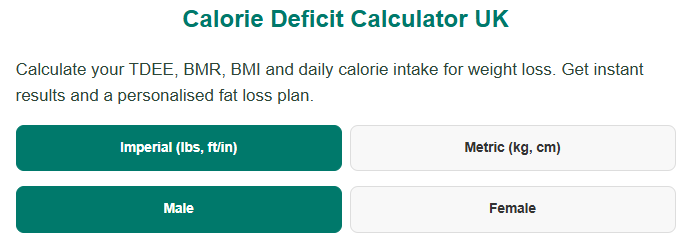
Rather than bouncing between a BMR calculator, a TDEE calculator, and a macro calculator, this tool does it all in a single calculation. You enter your age, gender, weight, height, activity level, goal weight, and timeline — and it returns your BMR, TDEE, BMI, recommended daily calorie intake, daily deficit, weekly fat loss projection, and full macronutrient breakdown.
That’s the kind of output a nutritionist would give you after a consultation. Except it’s free and takes about 45 seconds.
The macros are actually calculated, not guessed
A lot of calculators just give you a calorie number and leave you to figure out the rest. This one breaks down exactly how many grams of protein, carbohydrates, and fats you should be eating each day based on your goal. For people doing intermittent fasting, keto, or high-protein diets, this is genuinely useful rather than cosmetic.
It’s built around NHS-aligned safety limits
The calculator won’t push you toward dangerous intake levels. It flags when your targets would fall below 1,200 kcal (for women) or 1,500 kcal (for men) — the minimum safe thresholds according to UK health guidelines — and recommends extending your timeline rather than slashing calories further.
You can download your plan as a PDF
This might sound like a small thing, but for anyone who’s tried to remember their calorie targets three days after calculating them, having a document to refer back to makes a real difference to consistency.
It has dedicated calculators for specific needs
Beyond the main calculator, the site includes standalone tools for TDEE, BMR, and weight loss specifically — useful if you want to understand each component individually before putting the full picture together. The TDEE calculator in particular is clean, fast, and doesn’t require creating an account.
Real Questions People Ask — Answered Honestly
“Why am I gaining weight if I’m in a calorie deficit?” In the short term, this can happen because of water retention — especially when you start exercising more, eat more sodium, or are in a certain point of your hormonal cycle. Weight fluctuates by 1–2kg daily for completely normal reasons. Judge progress over weeks, not days.
“Do I need to eat back the calories I burn at the gym?” Generally, no. Your TDEE already accounts for your activity level if you selected it accurately. Eating back exercise calories usually tips people over their deficit without realising it. If you’ve had an unusually intense session, eating back roughly half is a reasonable compromise.
“Can I build muscle while eating at a deficit?” For complete beginners and those returning to training after a break — yes, to some extent, often called “newbie gains.” For experienced lifters, it’s much harder. If muscle building is a primary goal, you’re better served by eating at or slightly above maintenance with high protein intake.
“Is 1,200 calories a day safe?” For some petite, sedentary women, 1,200 might be close to their calculated intake. For most women — and essentially all men — it’s dangerously low and unsustainable. It leads to muscle loss, fatigue, disordered eating patterns, and metabolic adaptation. Always calculate your personal figure rather than defaulting to this number.
“What’s the difference between BMR and TDEE?” BMR is how many calories you’d burn lying in bed all day doing absolutely nothing. TDEE is what you actually burn across your real day. The gap between the two depends on how active you are — it’s typically 20–90% higher than BMR. Always build your deficit off TDEE, not BMR. Many people make the mistake of eating at their BMR thinking that’s maintenance — it’s not, it’s well below it.
A Simple Week-by-Week Approach That Actually Works
Instead of diving into extreme restriction, here’s what the evidence — and experienced fitness professionals — consistently recommend:
Week 1–2: Calculate and observe. Use a proper calculator to find your TDEE. Then eat at that number (maintenance) for one to two weeks while tracking honestly. This tells you whether the calculation is accurate for your body before you start cutting.
Week 3 onwards: Apply a moderate deficit. Subtract 300–500 calories from your TDEE. This is your daily target. Eat that consistently, including weekends.
| Goal | Daily Deficit | Expected Weekly Loss |
| Mild (ideal for beginners) | 250–300 kcal | 0.25 kg |
| Moderate (most recommended) | 500 kcal | ~0.5 kg |
| Faster (only if significant excess weight) | 750 kcal | ~0.75 kg |
| Aggressive (not recommended long-term) | 1,000 kcal | ~1 kg |
Every 4 weeks: Recalculate. Your TDEE drops as you lose weight. Recalculate every month and adjust your target accordingly. Don’t assume the number you started with is still correct.
Track consistency, not perfection. Hitting your calorie target six days out of seven is far more effective than being perfect for three weeks and then abandoning the whole thing. Progress is built on sustained habits, not flawless execution.
The Bottom Line
Calorie deficits work. The science on this is not complicated. But the application of that science — the part where you have to figure out what a deficit actually means for your specific body — is where most people come unstuck.
Generic numbers from the internet won’t cut it. What you need is a figure based on your age, weight, height, activity level, and goal. You need your BMR, your TDEE, your safe daily intake, and your macro targets all in one place.
That’s exactly what Calorie Deficit Calculator UK provides, for free, in under a minute. No subscription, no sign-up, no fluff — just the numbers your body actually needs, built around UK guidelines and trusted by fitness professionals who are tired of sending clients to tools that half-do the job.
If you’ve been going round in circles with your weight loss, start here. Get your real number. Then eat consistently at it. It really is that straightforward once you have the right data in front of you.
Always consult a qualified healthcare professional or registered dietitian before making significant changes to your diet, especially if you have an existing medical condition.
